New Episode Lessons
Episodes 21–50 continue the Money Smart Kids series with new stories and practical money concepts for children.
The first Money Smart Kids package builds the foundation. This upgrade continues the exact same journey with 30 brand-new episodes, taking the collection all the way from Episode 1 to 50.
Money Smart Kids was designed as a connected learning journey. Episodes 21–50 pick up where the first package ends and continue the story naturally.
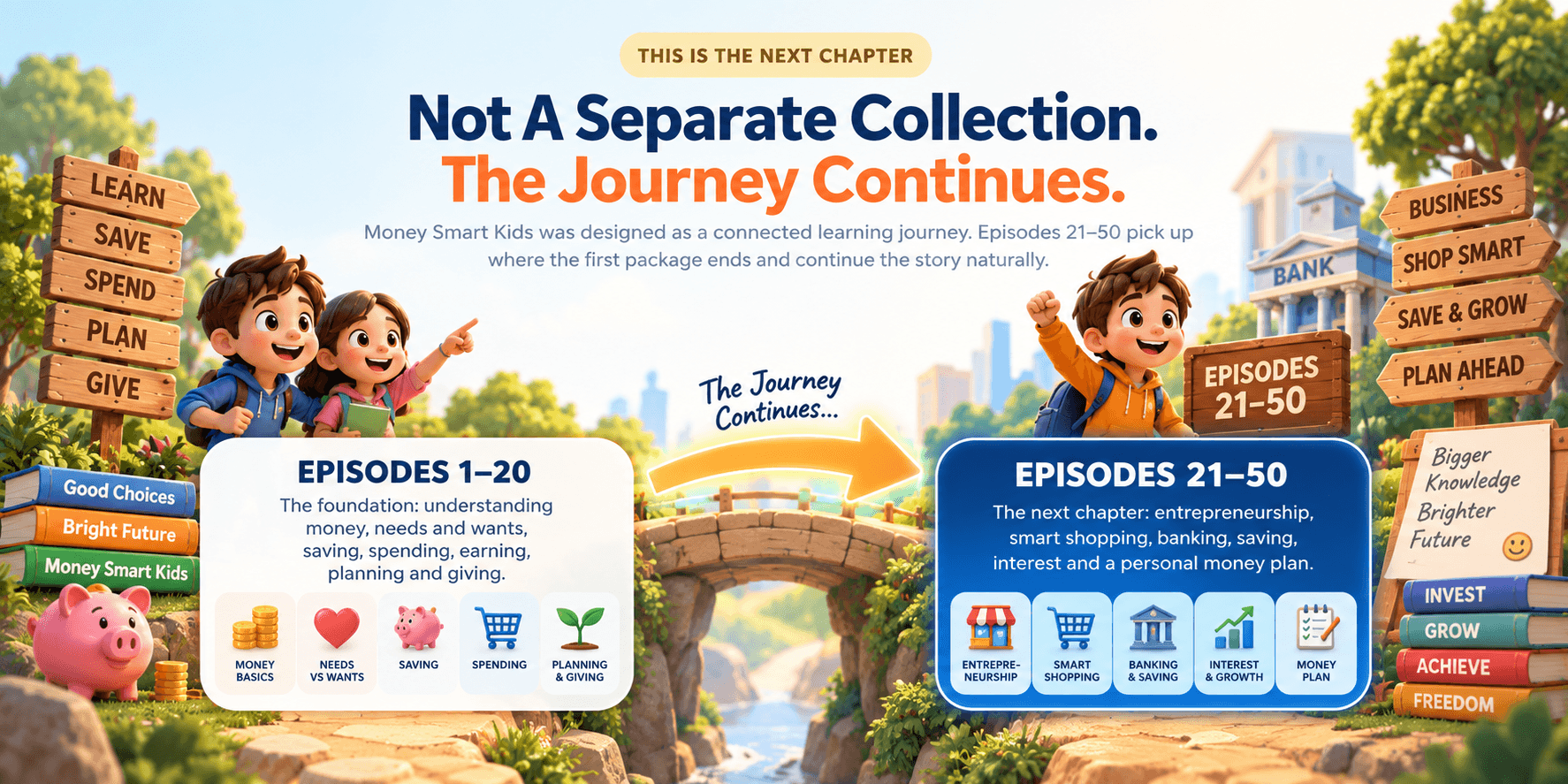
Continue from Episode 20 with the next 30 Money Smart Kids lessons, taking the complete learning sequence through Episode 50.
Episodes 21–50 continue the Money Smart Kids series with new stories and practical money concepts for children.
Episodes 21–35 explore products, customers, business plans, costs, pricing, sales, revenue, profit and expenses.
Episodes 36–40 help children compare deals, understand discounts, and make thoughtful buying decisions.
Episodes 41–50 introduce banks, savings accounts, interest, compound interest, financial goals and personal money planning.
Watch the episode previews on this page and review each lesson before deciding whether to upgrade.
Bring your original Episodes 1–20 together with Episodes 21–50 for a complete 50-episode learning journey.
Each episode preview on this page includes its title, Core Lesson and Core Takeaway, so you can see what children will learn throughout the continuation.
The first 20 episodes give kids the foundation. Once they understand the basics, the natural next questions begin:
What happens when I want to start a business? How do I choose what to sell? How much should I charge? What happens when I make a profit or a loss? And how can I save and grow my money over time?
Kids move from understanding money to exploring entrepreneurship, customers, products and simple business plans.
They discover costs, pricing, sales, revenue, profit, expenses and smarter ways to make business decisions.
They learn to compare deals, think about discounts, question “bigger is better,” and look beyond advertising.
The journey continues into banks, savings, interest, compound interest, financial goals and a personal money plan.
You already have the foundation. This upgrade gives you the continuation — taking Money Smart Kids from Episode 1 all the way through Episode 50.
WATCH THE 30 NEW EPISODES →Episodes 21–35 move from money basics into entrepreneurship — products, customers, business planning, costs, pricing, sales, revenue, profit and expenses.
Children learn the basic idea of entrepreneurship: creating or preparing something useful, offering it to customers, and earning money from sales.
Entrepreneurship can start with a simple idea: make or provide something useful, offer it to customers, and earn money when people buy it.
Children learn that choosing a product to sell means thinking about what people might want or need.
Before choosing something to sell, think about what people might want or need. Listening to potential customers can help you choose a better product.
Children learn that a business needs customers, and understanding what customers like or need can help a business sell its products.
Customers are the people who buy products or services. Understanding what customers like or need can help a business create products that people want to buy.
Children learn that a good business doesn't just make a product—it listens to customers and improves the product to make it more useful, attractive, or enjoyable.
A good entrepreneur listens to customers, notices problems, and improves the product to give customers more value.
Children learn that a simple business plan helps them organize their product, customers, materials, goal, and selling idea before starting a business.
A simple business plan helps an entrepreneur organize an idea before starting. It can include the product, customers, materials, goal, and how to sell.
Children learn that cost is the money a business spends to make or prepare a product for sale.
Cost is the money a business spends to make or prepare a product. Knowing the cost is important before deciding how much to charge customers.
Children learn that a business needs to choose a selling price for its product. The price should consider the cost of making the product and what customers may be willing to pay.
A selling price is the amount a customer pays for a product. Businesses should think about their costs, the value of their product, and what customers may be willing to pay when choosing a price.
Children learn that when a customer buys a product, the business receives money from the sale, called revenue or sales income.
Revenue is the money a business receives from selling its products or services.
Children learn that profit is the money left after a business subtracts its costs from its revenue.
Profit is the money left after a business subtracts its costs from its revenue.
Children learn that a business can have different expenses, such as materials, packaging, transportation, or tools needed to operate the business.
Business expenses are the different costs a business pays to operate, create products, and serve customers. Keeping track of expenses helps a business understand where its money goes.
Children learn that a healthy business needs to earn more money than it spends, so there is money left after paying expenses.
A business needs to watch its money carefully. When more money comes in than goes out, there is money left over that can become profit or be used to help the business grow.
Children learn that a business can sometimes spend more money than it earns, resulting in a loss. A loss is a signal to review the business and make smarter decisions.
A loss happens when a business spends more money than it earns. A loss doesn't always mean giving up—it can help an entrepreneur understand what needs to change.
Children learn that a business can increase its sales by reaching more customers, showing products clearly, and giving customers good reasons to choose the product.
A business can increase sales by reaching more customers, presenting products clearly, offering useful choices, and giving customers good value—without pressuring them to buy.
Children learn that changing a selling price can affect customer interest and business results. A lower price isn't automatically a better price.
A lower price may attract more customers, but it also means earning less from each product. A smart business considers cost, customer value, and sales before choosing a price.
Children learn that a smart selling price should consider cost, product value, customers, and business goals rather than simply choosing the cheapest or most expensive price.
A smart price considers the cost of the product, the value it provides, what customers may be willing to pay, and the business's goals.
Episodes 36–40 teach kids to compare deals, understand discounts, think about what they actually need, and look beyond advertising.
Children learn that smart shoppers should compare prices, quantities, and value before deciding which deal is better.
Smart shoppers compare price, quantity, and usefulness before buying. A deal is only useful when it gives you value for something you actually need.
Children learn that a discount can lower the price, but they should still ask “Do I need it?” and check the final price before buying.
A discount can make something cheaper, but buying something you don't need still means spending money. Smart shoppers check the final price and think about whether they really need the item before buying.
Children learn that a bigger package is not automatically a better deal. Smart shoppers compare price, quantity, and how much they actually need.
Bigger isn't always better. Smart shoppers compare price and quantity, but they also think about how much they actually need.
Children learn that a product with more features is not always the best choice. Smart shoppers choose based on what they actually need, not simply on how fancy a product looks.
A product with more features isn't always a better choice. Smart shoppers choose based on what they actually need and avoid paying extra for features they won't use.
Children learn that advertisements are designed to make products look exciting and attractive. Smart shoppers can enjoy advertisements while still thinking carefully before buying.
Advertisements are designed to attract attention and make products appealing. Smart shoppers don't automatically buy something because an advertisement looks exciting. They check the product, price, and their own needs before deciding.
Episodes 41–50 complete the journey with banks, savings accounts, interest, financial goals, compound interest, saving versus spending, and a personal money plan.
Children learn that a bank is a place where people can safely keep their money, and that a bank account helps people store and manage their money.
A bank can help people store and manage their money through bank accounts.
Children learn that a savings account can help them keep money for future goals and track how much they have saved.
A savings account can help people keep track of money they are saving for future goals. Saving regularly can help turn a small amount of money into a larger amount over time.
Children learn the basic idea that money kept in a savings account may earn interest, which can add to their savings over time.
Interest is extra money that a savings account may pay on money kept in the account. Interest can help savings grow over time.
Children learn that a big financial goal becomes easier when they set a target, break it into smaller amounts, and save regularly.
Big financial goals can become easier when you break them into smaller steps and save regularly.
Children learn the basic idea of simple interest: a savings amount can earn an additional percentage over time.
Simple interest is extra money calculated from the amount saved and the interest rate.
Children learn that when money stays in a savings account that earns interest, the balance can increase over time. Saving for longer can give the money more time to grow.
Time can help savings grow when money stays saved in an account that earns interest.
Children learn that starting to save earlier gives money more time to grow, especially when savings can earn interest.
Starting to save earlier gives your money more time to potentially grow through interest.
Children learn the basic idea of compound interest: when interest stays in a savings account, future growth can be based on the larger balance.
Compound interest means that interest left in the account becomes part of the balance, so future interest can be calculated on a larger amount.
Children learn that money can be used for things they want now or saved for future goals. Choosing to spend means giving up some of the opportunity to save that money for later.
Money gives us choices. Spending money now means we have less money available for future goals. Saving means choosing to wait for something that may matter more later.
Children learn how to create a simple personal money plan by deciding how much money to save, spend, and keep for future goals.
A money plan helps you decide what to do with the money you have.
After 50 connected episodes, kids don't just have isolated lessons. They have followed a complete journey from understanding money to creating a simple personal money plan.
A money plan helps you decide what to do with the money you have — how much to save, spend, and keep for future goals.
You already have Episodes 1–20. Add Episodes 21–50 and turn your collection into the complete 50-episode journey.
This offer is for customers who already own the first Money Smart Kids package.
Add all 30 continuation episodes and complete the Money Smart Kids journey through Episode 50.
Add Episodes 21–50 with the PLR license and complete your 50-episode Money Smart Kids collection.
This is an expansion for Money Smart Kids. Episodes 21–50 are designed to continue the journey from the first 20 episodes.
You get 30 new episodes, covering Episodes 21 through 50.
Yes. The upgrade is designed as a continuation of the existing Money Smart Kids sequence, taking the complete journey from Episode 1 through Episode 50.
The 30 episodes move through entrepreneurship, business costs and pricing, sales and profit, smarter shopping, banking, saving, interest, compound interest, saving versus spending, and personal money planning.
Yes. All 30 episodes are previewed on this page so you can watch the content and review the lessons before choosing the upgrade.
Email [email protected] for support.
The first 20 episodes started the journey. These next 30 episodes complete it. Take Money Smart Kids from Episode 1 all the way to Episode 50.
COMPLETE THE 50-EPISODE JOURNEY →